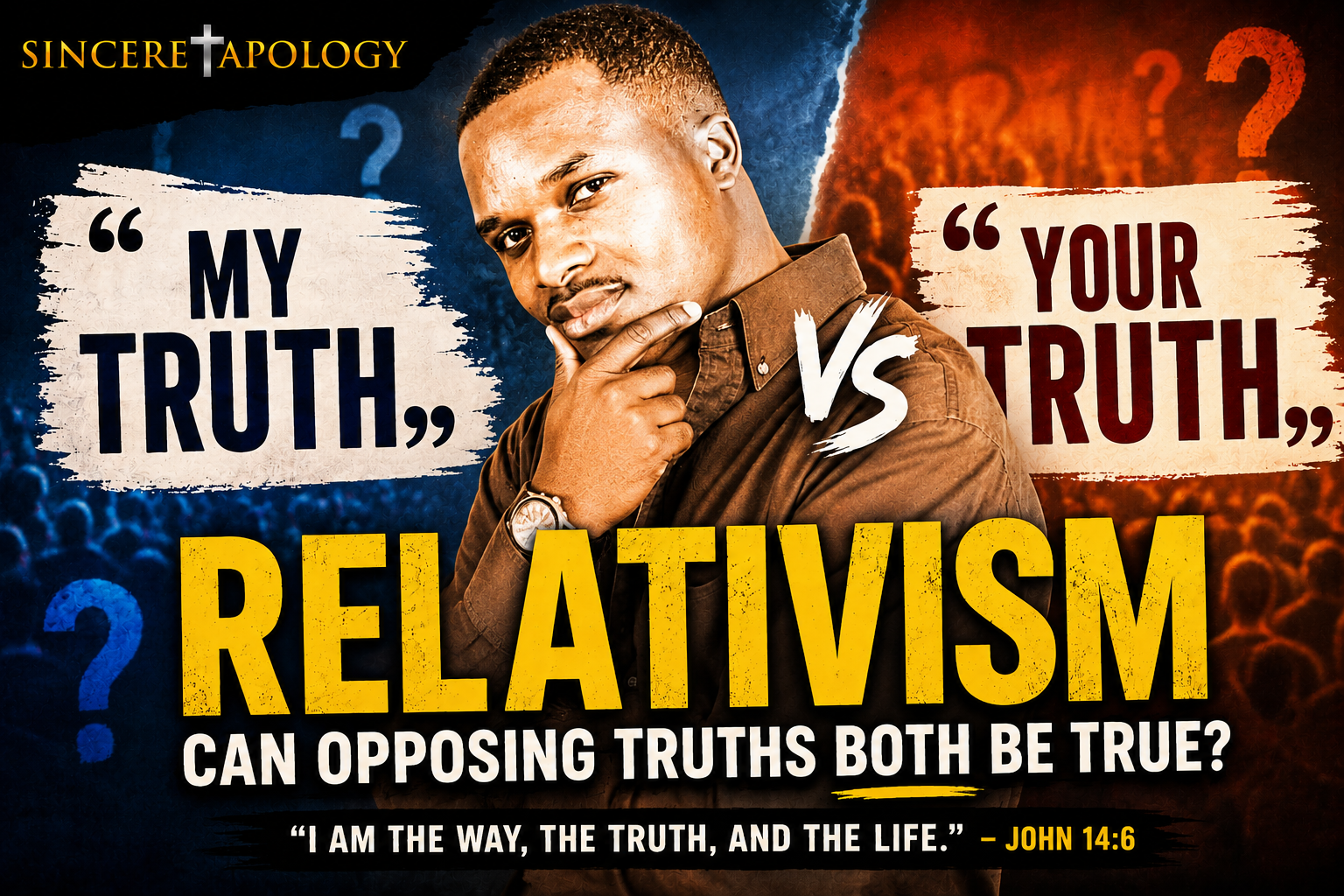
Relativism: Can “My Truth” and “Your Truth” Both Be True?
We hear it almost every day.
“That’s your truth.”
“But this is my truth.”
At first, those phrases sound kind, respectful, and open-minded. They seem to promote peace by allowing everyone to believe whatever feels right to them. But have you ever stopped to ask what those statements actually mean?
Can two completely opposite claims both be true?
Imagine one person says, “The light is on.”
Another says, “The light is not on.”
If both people are talking about the very same light at the very same moment, both statements cannot be true. One of them must correspond with reality.
Truth doesn’t become true because we believe it. Truth is true because it reflects reality.
That simple principle is something we rely on every single day.
If your GPS tells you to turn left, but the road only goes right, reality wins.
If your bank account says you have ten dollars, sincerely believing you have a million won’t change the balance.
If a doctor diagnoses an illness, we don’t ask for “our own truth.” We want the correct diagnosis because our lives depend on it.
In every area of life, we recognize that truth exists outside of our opinions.
So why should our understanding of God be any different?
The Bible consistently teaches that truth is objective because it comes from God’s unchanging character.
Jesus declared,
“I am the way, the truth, and the life: no man cometh unto the Father, but by me.” (John 14:6, KJV)
Notice that Jesus didn’t say, “I am one possible truth.”
He didn’t say, “I am your truth.”
He simply said, “I am the truth.”
Truth isn’t merely an idea. Ultimately, truth is found in the person of Jesus Christ.
Now, someone might respond, “Well, that’s true for you.”
But here’s a thoughtful question.
Is the statement “There is no absolute truth” itself absolutely true?
If it is, then the speaker has just admitted at least one absolute truth exists.
If it isn’t, then we have no reason to believe the statement.
Relativism often defeats itself.
The law of non-contradiction—a foundational principle of logic—reminds us that two contradictory statements cannot both be true in the same sense at the same time.
God is either the Creator or He is not.
Jesus either rose from the dead or He did not.
The resurrection cannot be both history and fiction simultaneously.
The apostle Paul understood this. In fact, he boldly wrote,
“And if Christ be not raised, your faith is vain.” (1 Corinthians 15:17, KJV)
Christianity does not ask people to believe something merely because it feels comforting.
It invites us to examine historical evidence, fulfilled prophecy, eyewitness testimony, and the consistency of God’s revealed Word.
Our faith is rooted in truth, not wishful thinking.
Now, let’s pause for a moment.
When people say, “This is my truth,” they are often expressing something very real. They may be describing their experiences, their hurts, their fears, or their personal journey.
Those experiences matter.
As Christians, we should listen with compassion before we speak.
But experiences are not the same as truth.
Someone may sincerely believe something that simply isn’t accurate.
Sincerity does not determine truth.
Reality does.
Think about Saul of Tarsus before he became the apostle Paul.
He sincerely believed he was serving God by persecuting Christians.
He wasn’t pretending.
He genuinely believed he was right.
Yet he was sincerely wrong until he encountered the risen Christ.
His sincerity didn’t make his beliefs true.
God’s truth corrected him.
The wonderful news is that God never reveals truth to embarrass us.
He reveals truth to rescue us.
Truth isn’t God’s way of pushing people away.
It’s His way of leading us home.
Jesus said,
“And ye shall know the truth, and the truth shall make you free.” (John 8:32, KJV)
Notice that truth brings freedom—not bondage.
It frees us from deception.
It frees us from confusion.
It frees us from hopelessness.
Our culture often tells us to look within ourselves for truth.
The Bible lovingly invites us to look beyond ourselves—to the God who created us, knows us, and loves us perfectly.
Our feelings change.
Our opinions change.
Culture changes.
But God does not.
As Malachi 3:6 reminds us,
“For I am the LORD, I change not.”
That means His truth is just as trustworthy today as it was yesterday and will be tomorrow.
This isn’t something to fear.
It’s something to celebrate.
Because if truth changes every day, we have nothing solid to stand on.
But if God’s truth is eternal, then we have an anchor for our souls.
If you’ve been searching for answers, don’t settle for whatever feels right in the moment.
Seek what is actually true.
Ask questions.
Examine the evidence.
Read the Scriptures with an open heart.
God is never threatened by honest questions.
In fact, He welcomes those who sincerely seek Him.
As Jesus promised,
“Seek, and ye shall find.” (Matthew 7:7, KJV)
So the next time you hear someone say, “That’s my truth,” remember this:
Everyone is entitled to their opinions.
Everyone deserves respect.
Everyone has a story worth hearing.
But truth itself doesn’t belong to any of us.
Truth belongs to God.
And because God is perfectly loving, perfectly just, and perfectly faithful, His truth is not meant to burden us.
It is meant to set us free.
If you’re searching for what is real, don’t merely ask, “What do I want to believe?”
Ask the far more important question:
“What is actually true?”
Because discovering God’s truth is not about winning an argument.
It’s about finding the One who said,
“I am the truth.”
And when we find Him, we find life.