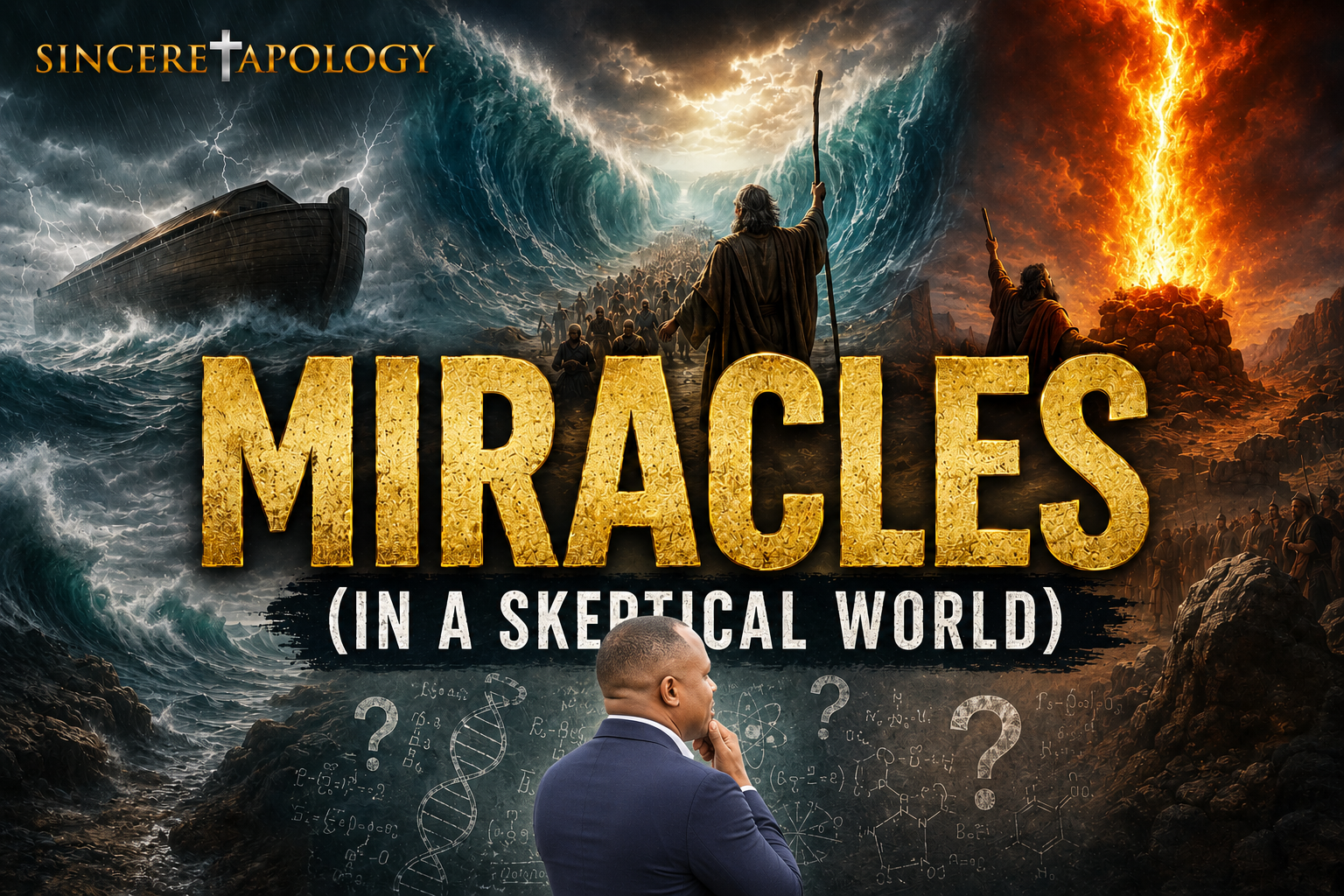
Miracles: Signs of God’s Presence in a Skeptical World
There are few subjects more inspiring—and more controversial—than miracles.
For some people, miracles are the heartbeat of faith. They are stories of healing, deliverance, provision, and divine intervention that remind humanity that God is near. For others, miracles are difficult to accept because they seem to conflict with science, reason, and the laws of nature. Philosophers such as David Hume argued that miracles are so improbable that no testimony should ever persuade us to believe them. Modern skepticism often treats miracles as myths, exaggerations, psychological experiences, or misunderstandings of natural events.
Yet the question remains:
What if miracles are not violations of truth, but revelations of a greater truth?
What if miracles are not irrational interruptions of creation, but moments where the Creator lovingly steps into His creation?
This conversation is not merely intellectual. It is deeply personal. Behind nearly every discussion about miracles is a wounded heart asking, “Does God still see me? Does He still act? Is hope still possible?”
The Christian faith answers with compassion and conviction: yes.
What Is a Miracle?
Biblically speaking, a miracle is not merely an unusual event. It is a work of God that reveals His power, character, and purpose.
In Scripture, miracles are often called “signs” and “wonders” because they point beyond themselves to God.
Jesus turned water into wine, healed the blind, calmed storms, fed multitudes, and raised the dead—not simply to amaze crowds, but to reveal the kingdom of God and awaken faith.
The apostle John explained this clearly:
“Jesus performed many other signs… But these are written that you may believe that Jesus is the Messiah, the Son of God.”
— John 20:30–31
Miracles in the Bible are never random displays of power. They are deeply connected to compassion, redemption, truth, and the glory of God.
When Jesus healed the leper, He touched the untouchable.
When He restored sight to the blind, He demonstrated that He is the Light of the world.
When He raised Lazarus, He revealed Himself as “the resurrection and the life.”
Every miracle carried theological meaning.
Do Miracles Violate Natural Law?
One of the most common objections to miracles is this:
“If natural laws govern the universe, how can miracles occur without violating science?”
This question deserves thoughtful consideration.
Christians throughout history have generally understood miracles not as contradictions of natural law, but as acts of the God who established those laws.
Natural laws describe the regular patterns through which creation normally operates. Gravity, biological processes, and physical forces are observable realities designed by God Himself. Science studies these patterns beautifully and meaningfully.
But Christians believe the Creator is not imprisoned by His creation.
An author is not trapped inside his own novel. A musician is not bound by a single note in the composition. Likewise, God is free to act within His universe according to His wisdom and purpose.
A miracle is not chaos overcoming order. It is the sovereign God working beyond ordinary processes for redemptive purposes.
In fact, the Bible consistently presents creation itself as sustained by God:
“In Him all things hold together.”
— Colossians 1:17
This means Christians do not see science and miracles as enemies. Science studies regularity; miracles are extraordinary acts of the One who designed that regularity.
The resurrection of Jesus, for example, is extraordinary precisely because resurrections do not ordinarily happen. Scripture never pretends otherwise. The miracle points to the authority of God over life and death itself.
David Hume and the Skeptical Challenge
The 18th-century philosopher David Hume remains one of the most influential critics of miracles.
Hume argued that miracles are violations of the laws of nature and that human testimony is always less reliable than the consistent experience supporting natural law. In simpler terms, he believed it is always more reasonable to assume witnesses were mistaken than to believe a miracle actually occurred.
Hume’s arguments shaped modern skepticism profoundly.
Yet many scholars have noted weaknesses in his reasoning.
First, Hume assumed a closed universe where miracles are impossible from the start. But if God exists, then miracles are at least possible. The debate cannot be settled merely by assuming naturalism beforehand.
Second, Hume underestimated the value of cumulative historical testimony. Courts, historians, and everyday human relationships all depend upon credible witness testimony. We regularly accept extraordinary events when supported by sufficient evidence.
Third, Hume lived before modern historical scholarship surrounding the resurrection of Jesus developed extensively. Today, even many non-Christian historians acknowledge certain historical facts surrounding Jesus’ death, the empty tomb traditions, and the rapid rise of resurrection belief among His followers.
The central issue becomes not whether miracles are common, but whether there is sufficient reason to believe God acted uniquely in history.
Christianity ultimately rests on one foundational miracle: the resurrection of Jesus Christ.
As the apostle Paul wrote:
“If Christ has not been raised, your faith is futile.”
— 1 Corinthians 15:17
Christian faith does not fear investigation. The resurrection was proclaimed publicly, examined by enemies, and defended by eyewitnesses willing to suffer and die rather than deny what they believed they had seen.
Can Miracles Be Historically Verified?
Some people assume miracles belong only to mythology because they cannot be scientifically repeated in laboratory conditions.
But history does not work like a laboratory.
No one can scientifically repeat the assassination of Abraham Lincoln or the signing of the Declaration of Independence. Historical events are evaluated through testimony, documents, context, evidence, and credibility.
The same principles apply when examining biblical miracles.
The New Testament documents were written within living memory of the events they describe. The writers named people, places, rulers, and witnesses. Christianity emerged in the very regions where these events supposedly occurred, among communities capable of challenging false claims.
This does not mean every miracle claim throughout history should be accepted uncritically. Christians are called to wisdom and discernment.
Not every emotional story is necessarily divine.
Not every claim on television or social media represents authentic faith.
The Bible itself warns against deception and false signs.
But rejecting every miracle claim automatically is not intellectual neutrality—it is a philosophical decision against the possibility of divine action.
The question is not merely, “Can miracles happen?”
The deeper question is, “Is there a God who can act within history?”
Are Miracle Claims Credible Today?
Many sincere believers testify that God still heals, provides, protects, and transforms lives today. Others remain cautious, especially after witnessing manipulation or false promises in religious settings.
This tension must be handled carefully and compassionately.
The Bible never teaches that miracles are entertainment or proof of spiritual superiority. Jesus often avoided sensationalism. In fact, some who witnessed miracles still rejected Him because miracles alone do not guarantee transformed hearts.
A biblically grounded view avoids two extremes:
1. Blind Credulity
Christians should not accept every claim uncritically. Truth matters. Integrity matters. Emotional experiences should be tested carefully.
2. Cynical Unbelief
At the same time, believers should not reduce God to a distant observer who never intervenes.
The God of Scripture is living, active, compassionate, and powerful.
Sometimes His miracles are dramatic. Sometimes they are quiet.
Sometimes healing comes instantly. Sometimes it comes through medicine, endurance, community, or spiritual restoration.
Sometimes the greatest miracle is not physical at all—but the transformation of a human heart.
A violent man becomes gentle.
An addict finds freedom.
A bitter soul discovers forgiveness.
A hopeless person encounters peace in Christ.
These miracles may not trend online, but heaven rejoices over them.
The Greatest Miracle: The Gospel Itself
The greatest miracle in Christianity is not merely that storms were calmed or diseases healed.
The greatest miracle is that sinful humanity can be reconciled to a holy God through Jesus Christ.
The gospel declares that God entered human history through Christ, bore humanity’s sin on the cross, rose victoriously from death, and offers eternal life to all who trust Him.
This is the miracle of grace.
A God who should reject sinners instead pursues them.
A Savior who deserved worship instead embraced suffering.
A tomb that should have remained sealed instead became empty.
And hearts once dead in sin become alive through the Holy Spirit.
The miracle of salvation is not escapism from reality. It is the restoration of reality according to God’s design.
A Compassionate Word for the Waiting Heart
Perhaps the hardest part of this discussion is not philosophical—it is personal.
What about the prayer that seemed unanswered?
What about the healing that did not come?
What about the loved one who still died?
These moments require tenderness, not shallow clichés.
The Bible never teaches that faith guarantees a pain-free life. Even faithful believers experienced suffering, persecution, and grief. Paul carried affliction. Timothy battled illness. Many biblical heroes endured seasons where God seemed silent.
Christian hope is not built on receiving every desired outcome immediately.
It is built on trusting the character of God revealed in Jesus Christ.
The cross reminds us that God is not distant from suffering. He entered it.
And the resurrection reminds us suffering does not have the final word.
Sometimes miracles happen instantly. Sometimes they unfold slowly. Sometimes their fullness awaits eternity.
But Scripture assures believers that God remains faithful even in the waiting.
Final Thoughts
Miracles will always provoke debate because they confront humanity with the possibility that reality is larger than materialism alone.
If God exists, miracles are possible.
If Jesus truly rose from the dead, then history itself has been forever changed.
Christianity does not ask people to abandon reason. It invites them to follow evidence honestly, think deeply, and remain open to the God who reveals Himself through both truth and love.
Miracles are not meant to glorify human personalities or create spiritual spectacle.
They point to Christ.
The ultimate purpose of every biblical miracle was to reveal the heart of God—a God who heals, restores, forgives, rescues, and calls humanity into relationship with Him.
And perhaps the greatest evidence of His power is this:
Broken people are still being transformed by His grace today.