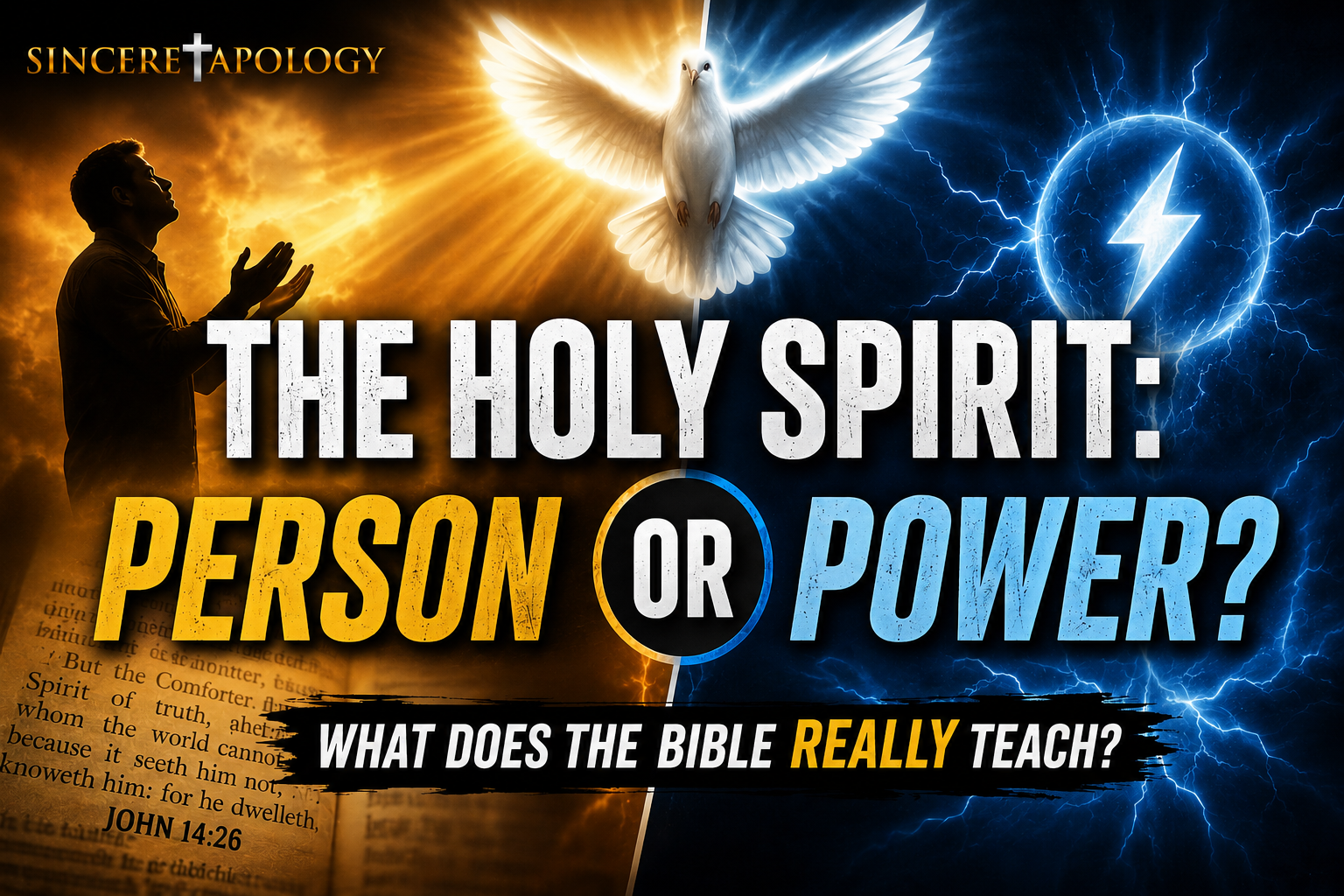
The Holy Spirit: Person or Power?
Understanding the Third Person of the Godhead Through Scripture
“But when He, the Spirit of truth, is come, He will guide you into all truth.” — Jesus Christ (John 16:13, KJV)
Many people believe in God the Father. Many believe in Jesus Christ. But when it comes to the Holy Spirit, confusion often follows.
Is the Holy Spirit simply God’s power? Is He merely a force like electricity or gravity? Or is the Holy Spirit an actual divine Person?
This isn’t just a theological debate. Your answer shapes how you pray, worship, understand the Bible, and experience God’s presence in your daily life.
Let’s examine what Scripture says.
Why This Question Matters
If the Holy Spirit is merely a force, then we simply try to “use” that power.
But if the Holy Spirit is a divine Person, then we enter into a relationship with Him.
The Bible consistently points to the second conclusion.
What Does the Bible Mean by “Person”?
Before we begin, let’s define what we mean.
A person is someone who can:
- Think
- Feel
- Make decisions
- Speak
- Love
- Teach
- Guide
- Be rejected
Notice that none of these qualities require having a physical body.
God the Father is Spirit (John 4:24).
Jesus existed before becoming human.
Likewise, the Holy Spirit possesses all the characteristics of personhood.
The Holy Spirit Speaks
Power does not speak.
Electricity cannot hold a conversation.
Gravity cannot give instructions.
Yet Scripture repeatedly shows the Holy Spirit speaking.
Jesus said,
“He shall not speak of himself; but whatsoever he shall hear, that shall he speak.”
(John 16:13, KJV)
Speaking requires intelligence, intention, and communication.
Only a person can do that.
The Holy Spirit Teaches
Jesus promised His disciples,
“But the Comforter, which is the Holy Ghost… he shall teach you all things, and bring all things to your remembrance.”
(John 14:26, KJV)
Teaching involves knowledge.
It involves understanding.
It involves communication.
Power cannot teach.
A person can.
The Holy Spirit Guides
Again Jesus declared,
“He will guide you into all truth.”
(John 16:13, KJV)
Guiding involves making choices and leading others intentionally.
GPS software gives directions because someone programmed it.
The Holy Spirit guides because He personally knows God’s will.
The Holy Spirit Has a Mind
Paul wrote,
“And he that searcheth the hearts knoweth what is the mind of the Spirit.”
(Romans 8:27, KJV)
Notice the wording.
Not “the force.”
Not “the energy.”
“The mind of the Spirit.”
Only a personal being possesses a mind.
The Holy Spirit Has a Will
Paul explains spiritual gifts by saying,
“Dividing to every man severally as he will.”
(1 Corinthians 12:11, KJV)
The Holy Spirit decides which gifts believers receive.
Decision-making is an act of will.
Power has no preferences.
Persons do.
The Holy Spirit Can Be Grieved
Paul gives this warning:
“And grieve not the holy Spirit of God.”
(Ephesians 4:30, KJV)
Can you hurt someone’s feelings?
Yes.
Can you grieve electricity?
Of course not.
Grief is emotional.
Only persons experience emotions.
The Holy Spirit Loves
Paul encouraged believers,
“For the love of the Spirit…”
(Romans 15:30, KJV)
Love is one of the greatest expressions of personhood.
Power cannot love.
The Holy Spirit does.
The Holy Spirit Can Be Lied To
One of the clearest passages appears in Acts 5.
Ananias lied about money he had given to the church.
Peter asked,
“Why hath Satan filled thine heart to lie to the Holy Ghost?”
(Acts 5:3, KJV)
Moments later Peter says,
“Thou hast not lied unto men, but unto God.”
(Acts 5:4, KJV)
Notice two remarkable truths.
First, people can lie to the Holy Spirit.
Second, Peter identifies the Holy Spirit as God.
You cannot lie to a force.
You lie to a person.
The Holy Spirit Intercedes
Romans 8 tells us,
“The Spirit itself maketh intercession for us.”
(Romans 8:26, KJV)
The older English translation uses “itself,” but the Greek language clearly refers to the Holy Spirit as a personal being.
Interceding means praying on behalf of another.
That requires understanding.
It requires compassion.
It requires personal involvement.
The Holy Spirit Can Be Resisted
Stephen told Israel,
“Ye do always resist the Holy Ghost.”
(Acts 7:51, KJV)
People resist people.
They do not resist electricity.
The Holy Spirit actively works in human hearts, yet people can reject His influence.
Jesus Called the Holy Spirit “He”
Perhaps the strongest evidence comes directly from Jesus Himself.
Notice how many times Jesus refers to the Holy Spirit as “He.”
“He shall teach…”
“He shall testify…”
“He shall guide…”
“He shall glorify me…”
(John chapters 14–16)
Jesus could have referred to the Spirit impersonally.
Instead, He consistently used personal language.
That should settle the question for anyone who accepts Christ’s authority.
Common Objection: “The Spirit Is Called the Power of God”
This is true.
The Holy Spirit does display God’s power.
Luke 1:35 connects the Holy Spirit with God’s power during the miraculous conception of Jesus.
But displaying power does not eliminate personhood.
Consider this example.
A police officer exercises governmental authority.
That authority is power.
Yet the officer remains a person.
Likewise, the Holy Spirit exercises God’s power because He is God—not because He is merely power.
Another Objection: “The Word Spirit Means Breath”
The Hebrew word ruach and the Greek word pneuma can mean breath, wind, or spirit.
Some conclude that the Holy Spirit is therefore only an impersonal force.
However, words gain meaning from context.
Jesus also called Himself “the Door” (John 10:9).
No one believes He is made of wood.
Jesus is called “the Lamb of God.”
No one imagines Him grazing in a field.
Biblical metaphors reveal truth without limiting identity.
The Holy Spirit may be compared to wind because His work is invisible, but that does not remove His personhood.
The Holy Spirit Is Fully Divine
The Bible attributes to the Holy Spirit qualities that belong only to God.
He is:
- Eternal (Hebrews 9:14)
- Omnipresent (Psalm 139:7–10)
- Omniscient (1 Corinthians 2:10–11)
- Creator (Genesis 1:2; Job 33:4)
No created force possesses these attributes.
Only God does.
What This Means for Your Life
If the Holy Spirit is merely power, then your goal is to access that power.
If the Holy Spirit is a divine Person, then your goal is to know Him.
He convicts.
He comforts.
He teaches.
He transforms.
He produces the fruit of the Spirit in believers.
Christianity is not about plugging into an invisible energy source.
It is about walking daily with the living God.
A Challenge from Jesus
Jesus left His followers with an incredible promise:
“Nevertheless I tell you the truth; It is expedient for you that I go away: for if I go not away, the Comforter will not come unto you; but if I depart, I will send him unto you.”
— John 16:7 (KJV)
Notice that Jesus did not promise to send an impersonal force.
He promised to send the Comforter—One who would continue Christ’s work by dwelling with His people.
Final Thoughts
The biblical evidence is overwhelming.
The Holy Spirit speaks.
He teaches.
He guides.
He loves.
He intercedes.
He chooses.
He can be resisted.
He can be grieved.
He is called God.
The Holy Spirit is not an “it.”
He is not simply divine energy.
He is the eternal, personal, and fully divine Spirit of God, working to draw people to Christ, transform lives, and glorify the Father.
The question is no longer whether the Holy Spirit is a Person.
The real question is:
Will you allow Him to lead your life?
Key Takeaways
- The Holy Spirit is a Person, not merely an impersonal force.
- Jesus consistently referred to the Holy Spirit as “He” (John 14–16).
- The Holy Spirit speaks, teaches, guides, loves, chooses, intercedes, and can be grieved, all of which are personal characteristics.
- The Holy Spirit is fully God, possessing divine attributes such as eternity, omnipresence, omniscience, and creative power.
- Christianity is not about harnessing a force but cultivating a relationship with the living God through His Spirit.
“Now the Lord is that Spirit: and where the Spirit of the Lord is, there is liberty.” — 2 Corinthians 3:17 (KJV)