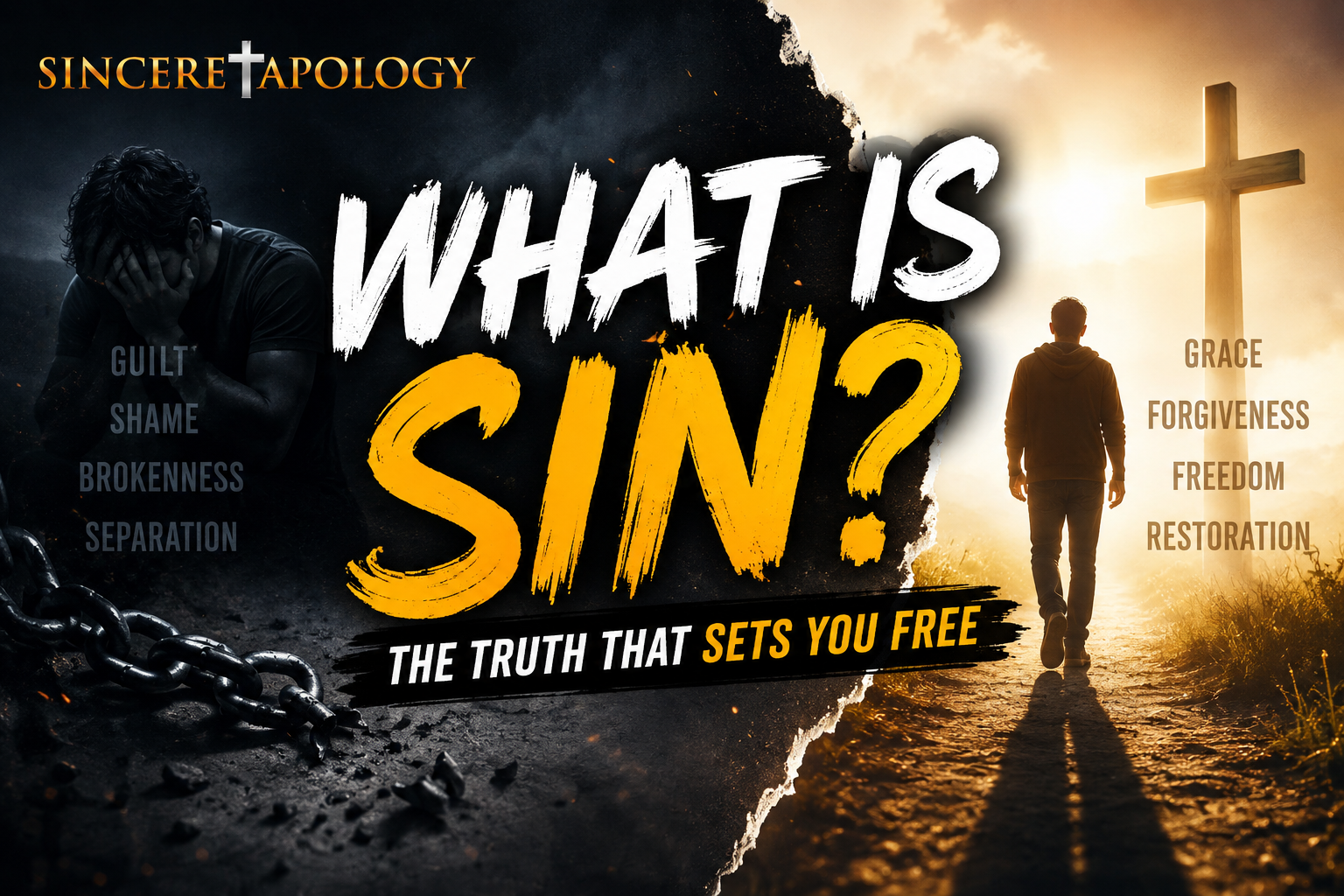
What Is Sin?
Understanding What Separates Us From God and How He Brings Us Home
The word sin can make people uncomfortable. For some, it brings memories of sermons filled with warnings. For others, it sounds outdated—a religious word from another generation used to describe things people are no longer ashamed to do. Still others hear the word and immediately think about the worst things a human being can do.
But what if our understanding of sin is too small? What if sin is not merely about breaking religious rules? What if sin is actually about a broken relationship? To understand sin biblically, we have to begin somewhere unexpected. We should not begin with human failure. We should begin with God’s love.
Sin Makes Sense Only When We Understand What We Were Made For
The Bible opens with a picture of humanity that is remarkably beautiful.
“So God created man in his own image…”
Genesis 1:27
Human beings were created in the image of God. We were designed for relationship with our Creator, relationship with one another, and harmony with God’s creation. Before Scripture tells us what went wrong, it tells us what was right. Humanity belonged with God. This is important because Christianity does not begin by saying human beings are worthless. It begins by saying we were created with extraordinary value. Sin does not make us valuable enough for God to rescue. God rescues us because He already values us. And that changes the conversation. The biblical message about sin is not God standing at a distance looking for reasons to condemn humanity. It is the story of a Creator watching something He loves become damaged—and choosing to rescue it.
So, What Is Sin?
The Bible gives several complementary descriptions.
One of the clearest is:
“Whosoever committeth sin transgresseth also the law: for sin is the transgression of the law.”
1 John 3:4
Sin involves rebellion against God’s moral will.
James adds another dimension:
“Therefore to him that knoweth to do good, and doeth it not, to him it is sin.”
James 4:17
Sin can therefore involve both doing what is wrong and refusing to do what we know is right.
Paul goes deeper still:
“For all have sinned, and come short of the glory of God.”
Romans 3:23
Notice the language: come short. Sin is not merely a list of prohibited behaviors. Sin is falling short of the life for which God created us.
It is choosing our way over God’s way. It is placing ourselves at the center of a life that was designed to have God at the center.
Sin says:
“I know what God says, but I want something else.”
Sometimes that rebellion is loud.
Sometimes it is quiet.
Sometimes it looks destructive.
Sometimes it looks respectable.
But underneath it is the same human tendency: we want God’s gifts while resisting God’s authority.
Sin Promises More Than It Can Deliver
We should acknowledge something that religious conversations sometimes avoid: Sin can be pleasurable. If sin never felt good, temptation would not be tempting. Scripture itself speaks of the temporary enjoyment associated with sin. Hebrews describes Moses as choosing God’s people rather than enjoying “the pleasures of sin for a season” (Hebrews 11:25).
Notice the last three words:
“For a season.”
That’s the part temptation rarely advertises.
Sin may offer pleasure.
Sin may offer excitement.
Sin may offer money.
Sin may offer attention.
Sin may offer sexual gratification.
Sin may offer revenge.
Sin may offer power.
Sin may offer acceptance.
Sin may offer escape.
And sometimes sin really does appear to deliver what it promised. At first. But sin has a way of presenting the pleasure while hiding the price.
It shows you the moment but not the morning after.
It shows you the excitement but not the emptiness.
It shows you the freedom but not the chains.
It shows you what you can gain but hides what you may eventually lose.
That is why temptation is so deceptive.
Sin rarely introduces itself as destruction. It usually introduces itself as satisfaction.
The First Temptation Followed the Same Pattern
In Genesis 3, the serpent did not approach Eve by saying:
“Would you like to destroy your relationship with God?” That probably would not have been very tempting. Instead, the forbidden fruit was presented as desirable.
Genesis says:
“And when the woman saw that the tree was good for food, and that it was pleasant to the eyes…”
Genesis 3:6
It looked good.
It seemed beneficial.
It appeared to offer something desirable.
That pattern has never really changed.
Temptation whispers:
You’ll be happier.
You’ll feel better.
You deserve this.
Nobody will know.
You can stop whenever you want.
God is keeping something good from you.
And beneath many temptations is an ancient suspicion:
Can God really be trusted with my happiness?
Sin asks us to believe that we can construct a better life apart from the One who gave us life.
The Problem Is Deeper Than Behavior
Jesus repeatedly moved beyond outward behavior to the condition of the heart.
He taught that murder has roots in anger and hatred (Matthew 5:21–22), and that adultery can begin with lust cultivated within the heart (Matthew 5:27–28).
Why?
Because God is not merely interested in making bad people behave better. He wants to transform human hearts.
We can change behavior while remaining unchanged inside.
A person can appear moral and still be filled with pride.
A person can attend church and still refuse forgiveness.
A person can speak about God while secretly wanting nothing to do with God’s authority.
This is why Christianity offers something greater than behavior modification.
Jesus offers transformation.
We Are All Standing on the Same Ground
One of the most important truths in any discussion about sin is found in Romans:
“For all have sinned, and come short of the glory of God.”
Romans 3:23
All. That word leaves very little room for spiritual arrogance. The Christian cannot stand above another human being and say, “Look how sinful you are.” We stand beside one another and say:
“We need the same Savior.”
Our sins may not look alike.
Our temptations may not be identical.
Our stories may be completely different.
But nobody reaches God by being morally superior to someone else.
The person struggling publicly needs grace.
The person struggling privately needs grace.
The skeptic needs grace.
The church member needs grace.
The preacher needs grace.
We all do.
The gospel does not divide humanity into good people and bad people.
It reveals sinful people and a gracious Savior.
What Does Sin Actually Do?
Isaiah gives us a sobering description:
“But your iniquities have separated between you and your God…”
Isaiah 59:2
Sin creates separation.
And separation from God is serious because God is the source of life.
Paul writes:
“For the wages of sin is death…”
Romans 6:23
This is not simply an arbitrary punishment attached to breaking God’s rules. Sin moves us away from the Source of life itself. Imagine a branch saying to the tree: “I want your fruit. I want your strength. I want your life. I simply don’t want to remain connected to you.” The branch cannot have both. Neither can we. We were made for communion with God. That is why sin eventually wounds us even when it initially pleases us. We are trying to live disconnected from the very One we were created to know.
But God Did Not Walk Away
This may be one of the most beautiful moments in Scripture.
After Adam and Eve sinned, they hid.
Genesis says:
“And Adam and his wife hid themselves from the presence of the LORD God…”
Genesis 3:8
Then God called:
“Where art thou?”
Genesis 3:9
God knew where Adam was. The question was not about geography. It revealed God’s pursuit. Humanity sinned. Humanity hid. God came looking. That pattern runs throughout Scripture.
We wander.
God calls.
We hide.
God seeks.
We fall.
God reaches.
And ultimately, God came all the way into our world in Jesus Christ.
Jesus Shows Us How Far God Will Go
The answer to sin is not merely “try harder.”
The answer is Jesus.
Scripture says:
“But God commendeth his love toward us, in that, while we were yet sinners, Christ died for us.”
Romans 5:8
Notice when Christ loved us.
Not after we fixed ourselves.
Not after we conquered every habit.
Not after we became religious.
Not after we proved ourselves worthy.
While we were yet sinners.
The cross is God’s declaration that He takes both sin and sinners seriously.
Sin is serious enough that Christ died.
But you are loved enough that Christ willingly came for you.
At Calvary, Jesus did not minimize sin.
He confronted its consequences and opened the way for reconciliation.
Paul explains:
“God was in Christ, reconciling the world unto himself…”
2 Corinthians 5:19
That word reconciling is beautiful. Christianity is not merely about avoiding punishment. It is about restoring a relationship. God wants you back.
You Do Not Have to Clean Yourself Up Before Coming Home
Sometimes people believe:
“I’ll come to God after I get myself together.”
But if we could completely repair ourselves, we would not need a Savior.
Jesus said:
“Him that cometh to me I will in no wise cast out.”
John 6:37
Come with the struggle. Come with the questions. Come with the addiction. Come with the guilt. Come with the secret. Come with the habit you promised yourself you would never repeat. Come with yesterday. Come with the thing you wish you could erase. Come. You do not take a bath before taking a bath. And you do not become spiritually clean before coming to Christ to be cleansed.
Repentance Is Not God Trying to Ruin Your Life
Jesus preached:
“Repent ye, and believe the gospel.”
Mark 1:15
Repentance is sometimes presented as though God is saying: “Stop having fun and start being miserable.” But biblical repentance is an invitation to turn around. God calls us away from sin because He knows where sin leads. Think of a parent seeing a child walking toward danger. “Turn around!” is not an expression of hatred. It is an expression of love. In the same way, when God calls something sinful, He is not trying to deprive humanity of joy. He is calling us away from something that ultimately separates, damages, enslaves, or destroys. God is not asking you to surrender your joy. He is asking you to stop looking for ultimate joy in places that cannot sustain it.
Forgiveness Is Really Available
Perhaps you are reading this while thinking:
“You don’t know what I’ve done.” That’s true. But God does. And the promise remains:
“If we confess our sins, he is faithful and just to forgive us our sins, and to cleanse us from all unrighteousness.”
1 John 1:9
Notice the two promises: Forgive. And cleanse. God does not merely want to erase your record. He wants to transform your life. David understood this after his own devastating moral failure. He prayed:
“Create in me a clean heart, O God; and renew a right spirit within me.”
Psalm 51:10
David did not simply ask God to remove consequences. He asked God to change him. That can become our prayer too: “God, don’t just forgive what I’ve done. Change what I desire.”
Grace Does Not Give Us Permission to Stay in Sin
Someone might ask:
“If God is willing to forgive me, why not keep sinning and ask forgiveness afterward?”
Paul anticipated that very question:
“Shall we continue in sin, that grace may abound? God forbid.”
Romans 6:1–2
Grace is not God’s permission to remain imprisoned. Grace is God’s power to walk out of the cell. Imagine someone paying an enormous price to free a prisoner, only for the prisoner to walk back inside because the cell had become familiar. God’s forgiveness is not an invitation to become comfortable with what Christ came to save us from. It is an invitation into a new life.
There Is Something Better Than Sin
This may be the part we most need to understand. God is not merely asking us to give something up. He is offering something better.
Jesus said:
“I am come that they might have life, and that they might have it more abundantly.”
John 10:10
The choice is not:
Sin and happiness versus God and misery. That is temptation’s advertising campaign. Jesus offers something sin cannot provide. Peace without pretending. Joy without regret. Love without exploitation. Identity without performance. Forgiveness without hiding. Freedom without bondage. Purpose beyond pleasure. Hope beyond death. And a relationship with the God who created you. There may be things God asks us to surrender. Some may be difficult to release. Some habits have been with us for years. Some relationships may be complicated. Some desires may not disappear overnight. Following Christ does not mean temptation instantly vanishes. But it does mean temptation no longer has to be your master.
You Are More Than the Worst Thing You Have Done
One of sin’s cruelest tricks happens after the pleasure is gone.
First temptation says:
“Do it.”
Then condemnation says: “Look what you’ve done. God could never want you now.” Don’t believe either lie. Your sin is real. But so is God’s grace. Your failure may be great. But Christ is greater. Your past may explain parts of your story. It does not have to write your ending.
Paul wrote:
“There is therefore now no condemnation to them which are in Christ Jesus…”
Romans 8:1
Christianity does not ask us to pretend that sin doesn’t matter. It tells us sin mattered so much that Jesus went to the cross—and you mattered so much that He was willing to go.
What Should I Do Now?
If you recognize sin in your life, you do not need to run from God.
Run to Him. Acknowledge what is wrong. Don’t excuse it. Don’t rename it. Don’t compare yourself with someone who appears worse. Bring it honestly before God. Believe that Jesus died and rose again. Confess your sin. Receive His forgiveness. Ask Him for a new heart. And begin walking with Him. You may stumble along the way. When you do, don’t make peace with the sin—but don’t run away from the Savior either. Keep coming back to Christ. Keep surrendering. Keep praying. Keep allowing God’s Word to reshape your thinking. Keep walking.
Maybe God Is Calling You Home
Perhaps the real question is no longer simply: “What is sin?” Perhaps the deeper question is: “What is sin doing to me?” Is it giving you what it promised? Has the pleasure produced peace? Has getting what you wanted made you whole? Or are you discovering that something can feel good for a moment while slowly taking something precious from you? God is not exposing sin because He hates you. He wants to separate you from the thing that is separating you from Him. And He has already made reconciliation possible. Jesus has opened the door. You do not have to earn your way through it. You simply have to come.
You can pray:
“God, I know that I have sinned. I have chosen my way instead of Yours. I don’t want to hide from You anymore. I believe that Jesus died for my sins and rose again. Please forgive me. Cleanse my heart. Change the things within me that need to change. Teach me to love what You love and to let go of what is hurting my relationship with You. I give You my past, my present, my struggles, and my future. Help me begin again. In Jesus’ name, amen.”
The story does not have to end with sin. It can end with forgiveness. It can end with restoration. It can end with freedom. It can end with someone who had wandered discovering that God was calling them home all along.
“For the wages of sin is death; but the gift of God is eternal life through Jesus Christ our Lord.”
Romans 6:23
Sin pays wages.
God gives a gift.
And the gift is still being offered.