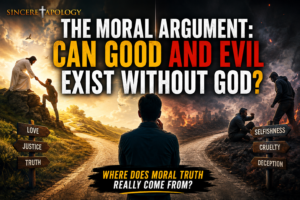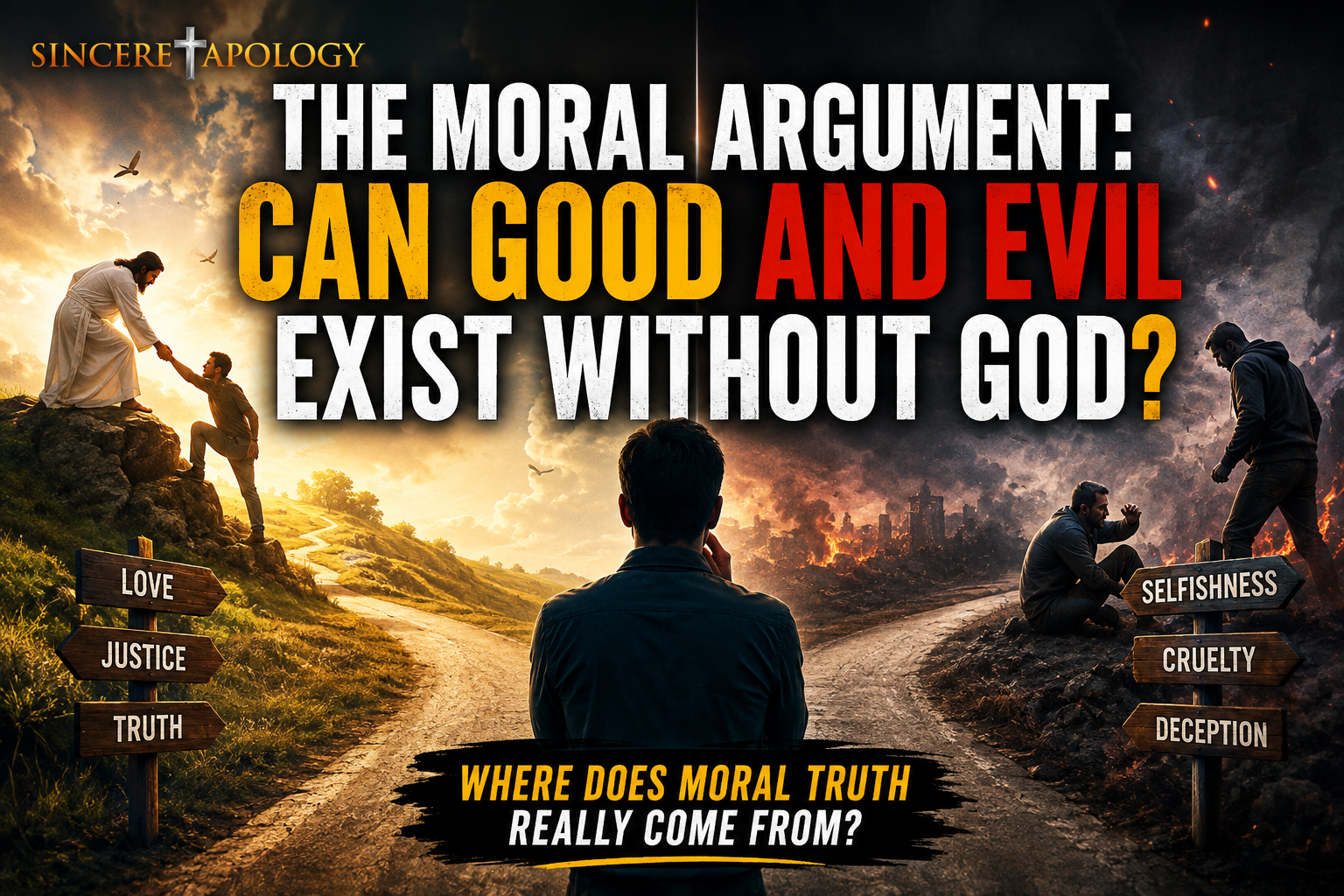
The Moral Argument: Can Good and Evil Exist Without God?
Most of us have encountered something that made us say, “That is wrong.” We don’t simply mean that it is unpleasant, unpopular, or something we personally dislike. We mean that something about the action itself is wrong.
When an innocent person is deliberately harmed, when a child is abused, when someone is exploited because they are vulnerable, or when cruelty is celebrated instead of condemned, something within us protests. We instinctively believe some things ought not happen.
At the same time, we admire compassion, courage, honesty, justice, sacrifice, and love. We don’t merely say, “I happen to prefer kindness.” We often speak as though kindness is genuinely better than cruelty.
But that raises one of life’s deepest questions: Where does that “ought” come from? Why should human beings be good? Even more fundamentally, what makes anything objectively good or evil in the first place?
This is where the moral argument for God’s existence begins.
It does not begin by pretending that Christians are morally superior to everyone else. Christians fail morally too. Nor does it claim that people who don’t believe in God cannot be kind, compassionate, courageous, or moral. Clearly, they can.
The deeper question is not, “Can someone be good without believing in God?” The question is, “Can objective good and evil ultimately exist if there is no God?”
Those are very different questions, and the difference is worth exploring.
1. We Don’t Just Have Moral Feelings—We Make Moral Claims
Imagine seeing someone intentionally torment an innocent child simply because they enjoy watching the child suffer. Most people would not respond, “Personally, that’s not my preference.” We would say, “That is wrong.”
But notice what we mean. We aren’t merely describing our feelings about the action. We are saying something about the action itself. There is a significant difference between saying, “I don’t like this,” and saying, “This should not be done.” The first describes a preference. The second describes a moral obligation.
Suppose someone says, “Vanilla ice cream is better than chocolate.” Someone else can reasonably respond, “Not to me.” Nothing profound follows because taste is subjective. But suppose someone says, “Torturing innocent people for entertainment is wrong.” If another person responds, “Not to me,” we don’t normally conclude that both positions are equally valid.
Why? Because somewhere deep within human reasoning, we recognize that morality appears to be about more than preference.
The Bible describes this remarkable moral awareness:
“Which shew the work of the law written in their hearts, their conscience also bearing witness…”
Romans 2:15
Paul points to something humanity experiences across cultures: conscience. Our consciences are not infallible. They can be educated, distorted, ignored, or hardened. Yet our persistent awareness of moral obligation raises an extraordinary question: Why do creatures in a purely material universe believe that some things ought to be done and other things ought never to be done?
2. What Is Objective Morality?
This distinction is crucial. Subjective morality depends ultimately upon an individual’s feelings, preferences, or judgments. Objective morality, however, means that some things are genuinely right or wrong regardless of what an individual—or even an entire society—happens to think about them.
For example, if deliberately abusing an innocent child is objectively wrong, then it remains wrong even if the abuser approves, even if the majority approves, even if the government approves, and even if a culture someday decides to celebrate it.
Popularity cannot transform evil into good. That means objective morality must somehow stand above human opinion. This creates an important question: If morality is above us, what is its foundation?
3. Can Society Determine What Is Good?
Perhaps morality comes from society. Societies certainly influence moral behavior. Families teach values, governments make laws, communities establish expectations, and cultures reward some behaviors while discouraging others.
But there is a problem with making society the ultimate foundation of morality: societies can be wrong.
History makes this painfully clear. Human societies have defended slavery, racial oppression, genocide, exploitation, persecution, abuse, and countless other injustices. Sometimes these practices were not hidden violations of society’s standards; they were supported by society’s standards.
Yet we look backward and say, “That society was wrong.” But think carefully about that statement. If society creates morality, how could society ever be morally wrong? A culture could change. A culture could become different. But on what basis could we say the previous culture was genuinely evil?
To morally condemn a society, we must appeal to a standard higher than that society.
The prophet Isaiah warned:
“Woe unto them that call evil good, and good evil…”
Isaiah 5:20
The biblical worldview does not allow popularity to determine morality. A thousand people agreeing that something evil is good cannot make it good. Consensus can measure opinion, but it cannot manufacture truth.
4. What If the Majority Decides?
Perhaps morality is determined democratically: whatever most people believe is right becomes right. But imagine a society in which 51 percent of the population decides that the remaining 49 percent have no rights. Would the oppression suddenly become morally good because it received enough votes? Surely not.
Majorities can be mistaken, manipulated, prejudiced, and capable of supporting injustice. If something is wrong only when enough people vote against it, then human rights become frighteningly fragile. Your dignity would ultimately depend upon someone else’s approval.
Biblical morality offers something far stronger:
“God created man in his own image…”
Genesis 1:27
Your worth does not originate with the government. Society did not give it to you, a political majority cannot manufacture it, and human beings cannot legitimately erase it. Your dignity is rooted in something higher than humanity: you bear the image of God.
5. What About Evolution?
Some propose that morality developed because cooperative behavior helped human communities survive. There may indeed be evolutionary or social explanations for why certain moral instincts or cooperative behaviors became common.
But explaining how we came to believe something is different from explaining why that belief is objectively true.
Suppose evolution gave us a powerful instinct to protect our children. That might help explain the instinct, but it doesn’t yet answer the philosophical question: Why is protecting innocent children morally good?
Survival itself cannot automatically become the definition of goodness. Sometimes doing what is right can actually decrease someone’s chance of survival. Imagine someone sacrificing his life to save strangers. From a strictly self-preserving standpoint, he has lost everything, yet morally we may describe his action as heroic.
Jesus said:
“Greater love hath no man than this, that a man lay down his life for his friends.”
John 15:13
Christianity recognizes something profound: the highest moral good is not always self-preservation. Sometimes love calls us to sacrifice.
6. The Moral Argument
We can now express the basic argument quite simply. If objective moral values and duties truly exist, there must be an adequate foundation for them beyond individual or societal preference. Objective moral values and duties do appear to exist. Therefore, there is good reason to believe in a transcendent moral foundation.
The Christian identifies that foundation with God.
But an important clarification is necessary. Christians are not claiming, “Whatever God randomly decides becomes good.” Biblically, goodness is grounded in who God is.
Scripture says:
“God is love.”
1 John 4:8
It also declares:
“The LORD is righteous in all his ways, and holy in all his works.”
Psalm 145:17
And:
“For I am the LORD, I change not…”
Malachi 3:6
God does not consult some moral law above Himself to discover what goodness means, nor does He arbitrarily invent goodness from moment to moment. Rather, goodness is rooted in God’s unchanging character. God does not merely tell us what is good; God is the ultimate foundation of goodness.
7. Why God’s Character Matters
Think about what happens if ultimate reality is merely impersonal matter and energy. Atoms don’t issue moral commands. Gravity doesn’t tell you to love your neighbor. Chemistry cannot declare injustice evil, and electrons cannot create human dignity.
Matter can describe what is. Moral obligation concerns what ought to be.
The Bible presents a radically different picture of reality. At the foundation of existence is not merely matter; there is a personal, rational, moral Creator, and humanity was made in His image.
That helps explain why we experience moral reality the way we do. We value love because our Creator is loving. We recognize justice because God is just. We understand faithfulness because God is faithful. We recognize human dignity because human beings bear God’s image.
Moral truth is not floating meaninglessly through the universe. It reflects the character of the One who made the universe.
8. But Why Do People Disagree About Morality?
This is an important objection. If objective morality exists, why do people disagree about moral issues?
Disagreement does not prove that objective truth doesn’t exist. People disagree about science, but that doesn’t mean there are no scientific facts. People disagree about history, but that doesn’t mean nothing actually happened. People disagree about mathematics, but that doesn’t make every answer correct.
Similarly, moral disagreement does not necessarily mean there is no moral truth. Sometimes disagreement actually assumes that moral truth exists. When two people argue about justice, they are usually not saying, “There is no such thing as justice.” They are often arguing, “My understanding of justice is more accurate than yours.”
The disagreement may reveal our limited understanding. It does not automatically eliminate the reality we are trying to understand.
9. Our Conscience Needs Something Higher Than Itself
We should also be careful not to make conscience our god. People sometimes say, “Just follow your heart.” That sounds comforting, but Scripture gives a warning:
“The heart is deceitful above all things…”
Jeremiah 17:9
Our feelings matter, but they are not always reliable moral authorities. I can sincerely desire something that is harmful. I can sincerely believe something that is false. I can sincerely justify something because it benefits me. Human beings are remarkably talented at reasoning ourselves into conclusions we already wanted.
That is why we need a moral standard greater than, “It feels right to me.”
Proverbs says:
“There is a way which seemeth right unto a man, but the end thereof are the ways of death.”
Proverbs 14:12
Something can seem right without actually being right. Objective morality challenges us to ask a harder question—not merely, “What do I want?” but “What is actually good?”
10. God’s Moral Law Is Not Designed to Destroy Our Happiness
Sometimes God’s commands are portrayed as arbitrary restrictions designed to keep people from enjoying life. But if God is our Creator, His moral instructions take on an entirely different meaning. The One who designed human beings understands what helps human beings flourish.
Jesus summarized God’s moral expectations around love:
“Thou shalt love the Lord thy God with all thy heart…”
“Thou shalt love thy neighbour as thyself.”
Matthew 22:37, 39
At the center of biblical morality is rightly ordered love: love God and love people. Tell the truth, protect the vulnerable, honor others, practice faithfulness, reject exploitation, forgive, show mercy, and pursue justice.
Why? Because these principles reflect God’s character. God’s moral law is not the fence of a cruel jailer; it is the wisdom of a loving Creator.
11. The Moral Argument Eventually Turns the Question Toward Us
There is an uncomfortable consequence to believing in objective morality. If objective good and evil exist, then morality isn’t merely something we can use to judge everyone else. It judges us too.
It is easy to point toward history’s worst offenders and say, “That was evil.” It is harder to examine ourselves. Have I always told the truth? Have I always treated others with dignity? Have I always loved people as I should? Have I ever harbored hatred, acted selfishly, taken advantage of another person, refused forgiveness, or known the right thing to do and deliberately chosen otherwise?
Suddenly, the moral argument becomes more than an argument for God’s existence. It becomes a mirror.
Paul writes:
“For all have sinned, and come short of the glory of God.”
Romans 3:23
Christianity does not teach that Christians are the good people and everyone else is bad. Christianity teaches that all of us need grace.
12. The God Who Gives the Moral Law Also Offers Mercy
This is where Christianity’s moral message becomes extraordinarily beautiful. The God whose goodness exposes our failures is also the God who came to rescue us from them.
Jesus did not enter the world merely to announce, “You have failed.” We already have. He came to save.
“For God so loved the world, that he gave his only begotten Son…”
John 3:16
At the cross, justice and mercy meet. God does not pretend evil is good, nor does He redefine sin because we struggle with it. But neither does He abandon sinners because we have failed.
Scripture says:
“But God commendeth his love toward us, in that, while we were yet sinners, Christ died for us.”
Romans 5:8
That means the moral law ultimately points beyond itself. It shows us what goodness looks like, reveals where we have fallen short, and helps us understand why we need grace.
13. Jesus Shows Us What Goodness Looks Like
If you want to know what Christian morality looks like when it takes on flesh, look at Jesus. Watch Him touch people others avoided, defend the vulnerable, forgive, confront hypocrisy, welcome children, show compassion to sinners without pretending sin was harmless, feed the hungry, weep beside a grave, wash His disciples’ feet, and finally hang on a cross praying for those responsible for His suffering.
Christian morality reaches its highest expression not in domination but in self-giving love.
Jesus did not merely teach us to love our enemies; He loved His. He did not merely teach forgiveness; He forgave. He did not merely teach sacrifice; He sacrificed Himself. The moral law ultimately reflects a God whose character is seen most clearly in Jesus Christ.
14. So Can Good and Evil Exist Without God?
Someone can certainly recognize good without believing in God. Someone can perform extraordinary acts of kindness without believing in God. Someone can defend human rights, love their family, sacrifice for others, and oppose injustice without professing Christianity.
The moral argument should never be used to deny those obvious realities.
The deeper philosophical question remains: If there is no transcendent moral reality, what makes these things objectively good?
If morality ultimately rests upon individual preference, individuals can change their preferences. If morality ultimately rests upon society, societies can change their standards. If morality rests upon governments, governments can change their laws. If morality rests upon majority opinion, majorities can change their minds.
But if morality is rooted in the character of an eternal, righteous, loving God, then there is a standard that stands above individuals, cultures, governments, generations, and civilizations.
Human wisdom does not create morality. At its best, human wisdom discovers and reflects a moral reality greater than itself.
15. Perhaps Our Moral Longing Is Pointing Somewhere
There is something fascinating about humanity. We don’t simply want pleasure; we want justice. We don’t merely want survival; we want meaning. We don’t merely want relationships; we want faithfulness. We don’t merely dislike suffering; we believe innocent people shouldn’t suffer unjustly.
When terrible injustice escapes human courts, something within us cries, “Someone should answer for this.” Why?
Perhaps our hunger for justice is telling us something about the universe. Perhaps our awareness of moral obligation is not an evolutionary accident or cultural illusion. Perhaps conscience is a signpost. Perhaps the reason we keep reaching for a standard higher than humanity is because there really is One.
A Question Worth Taking Personally
The moral argument is not meant merely to help Christians win debates. It should cause all of us to think.
Where does your understanding of good come from? If society changes its mind tomorrow, does good become evil? If everyone approves something wrong, does approval make it right? If nobody discovers an injustice, does the injustice cease being evil? If human beings possess genuine dignity, where did that dignity come from? And if objective morality exists, what best explains it?
Christianity offers an answer. Behind moral law is not merely a rulebook but a Moral Lawgiver. Behind justice is a just God. Behind love is a God who is love. Behind human dignity is a Creator who made humanity in His image. And behind our moral failures stands a Savior with open arms.
More Than an Argument
Perhaps you began this discussion wondering whether morality can exist without God. But maybe the more important discovery is that the God who establishes what is good is Himself good.
David wrote:
“O taste and see that the LORD is good…”
Psalm 34:8
God does not ask you to trust morality invented by changing human cultures. He invites you to discover goodness rooted in His unchanging character. When His goodness reveals areas of your life that need to change, don’t run from Him. Run toward Him.
The same God who shows us what righteousness is also knows every place where we have fallen short, and He still loves us. He still calls us. He still forgives. He still transforms. Through Jesus Christ, we can be reconciled to the God whose goodness we have failed to perfectly reflect.
So perhaps the moral argument leaves us with something greater than, “Does God exist?” It leaves us asking, “If God is the source of goodness, am I willing to trust Him enough to let His wisdom—not my desires, my culture, or the changing opinions of society—define what is good?”
That question reaches beyond philosophy and reaches the heart. Truth does not become truth when we agree with it. Good does not become good when society approves it, and evil does not become good when culture changes its name.
If objective morality is real, then goodness must stand above us rather than originate within us.
Christianity points us toward the One who does.
“He hath shewed thee, O man, what is good…”
Micah 6:8
Perhaps the deepest invitation of the moral argument is not simply to believe that there is a God. It is to discover that God is good—and then to trust Him enough to follow where His goodness leads.